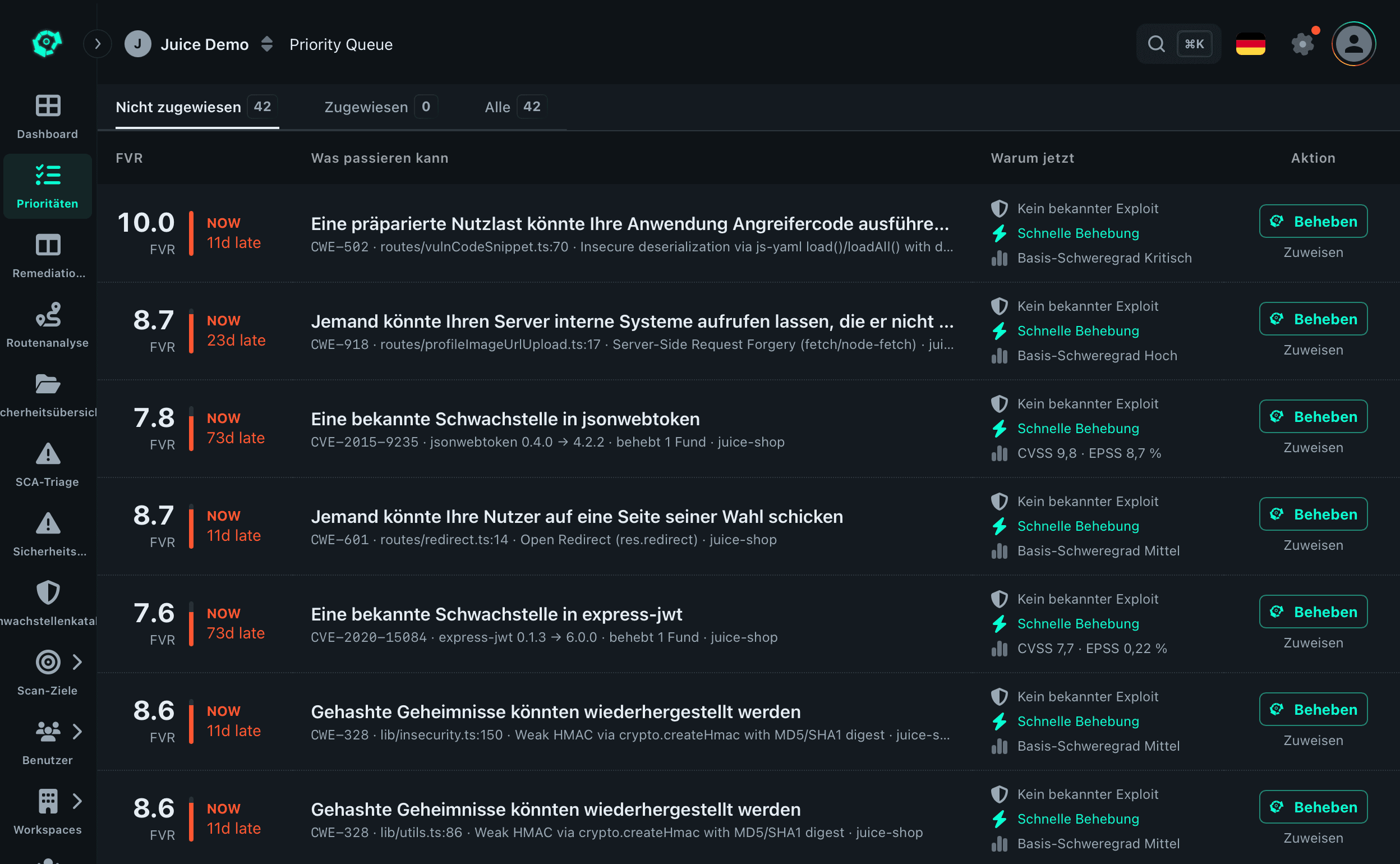
After nearly two years of intensive research and development, we are introducing the new Farion Agentic SAST Engine.
Earlier this summer, we presented the first version of our approach combining static data flow analysis with small language models. Starting today, our new hybrid Agentic SAST Engine powers scanning in Farion.
We built the engine to make frontier-level security analysis efficient enough to run continuously in CI/CD pipelines and independent of proprietary frontier models.
Digital sovereignty is central to that goal. Farion can be hosted in Europe, with fully on-premises and air-gapped deployment options in the future. These options are particularly important in regulated industries.
How the Agentic SAST Engine works
The engine combines static program analysis with a specialized agentic AI model in three stages.
1. Cross-language intermediate representation
First, the engine translates source code into a common intermediate representation (IR). The IR provides the foundation for field-sensitive and context-sensitive analysis of program behavior.
The engine has language frontends for Java, JavaScript, TypeScript, Go, Rust, C, C++, C#, Kotlin and Python.
2. Static data flow analysis with the Rust engine
Next, our analysis engine, written in Rust, processes the IR to compute context-sensitive and path-sensitive data flows.
Several fixed-point algorithms let the engine statically resolve complex language and runtime constructs such as lambdas, exceptions, closures and higher-order functions and account for them in its data flow analysis.
This architecture is especially effective for long, complex data flows. It lets the engine trace relationships across functions and modules throughout an application.
3. Agentic analysis with a specialized 28B model
The engine first evaluates the data flows statically, then makes them available for AI-assisted analysis in a highly compressed binary format.
A model with 28 billion parameters, trained specifically for this task, uses specialized tools to navigate the analysis graphs, inspect relevant data flows and assess the security implications of the results.
The static analysis engine handles the compute-intensive work of processing source code and reconstructing data flows. The model works with a structured, compressed representation of program behavior.
This substantially reduces the compute and context the model needs and lets it analyze long, complex data flows efficiently.
Snyk VulnBench 2.0
In our internal evaluation, Farion performed on par with Claude Opus 5 and Claude Opus 5 combined with Snyk Code. We based the evaluation on Snyk VulnBench 2.0.
All benchmark results
| Rank | Tool / Agent | System type | Macro Recall | Macro Precision | Balanced F1 Score |
|---|---|---|---|---|---|
| 1 | Farion SAST | SAST API / Scanner | 85.7% | 78.3% | 81.8% |
| 2 | Claude Opus 5 (xhigh Security Review) | AI Coding Agent | 84.2% | 78.5% | 81.3% |
| 3 | Claude Opus 5 + Snyk MCP | AI Coding Agent + Tool | 78.7% | 83.5% | 81.0% |
| 4 | Claude Sonnet 5 (xhigh Security Review) | AI Coding Agent | 70.5% | 76.2% | 73.3% |
| 5 | Snyk Code | SAST Scanner | 87.3% | 48.0% | 61.9% |
| 6 | Codex Security (Luna xhigh) | AI Security Agent | 43.2% | 21.1% | 28.4% |
| 7 | Codex Security (Terra xhigh) | AI Security Agent | 29.5% | 17.6% | 22.0% |
| 8 | DeepSec (Claude Opus 5, 150 Turns) | AI Benchmark Agent | 28.3% | 8.0% | 12.4% |
| 9 | Codex Security (Sol xhigh) | AI Security Agent | 27.9% | 12.9% | 17.6% |
| 10 | DeepSec (Codex Sol, 150 Turns) | AI Benchmark Agent | 0.0% | 0.0% | 0.0% |
Hardware and deployment
Combining deterministic program analysis with a specialized model lets us run the AI on relatively modest hardware.
A single NVIDIA H200 or two NVIDIA RTX PRO 6000 Blackwell GPUs are sufficient to run our 28B model. Quantization can reduce hardware requirements further.
That makes AI-assisted security analysis practical for both occasional audits and continuous use during development.
The architecture also reduces reliance on external model providers and lets organizations run the engine on infrastructure they control.
Availability
The new Farion Agentic SAST Engine is available now for backend applications built with Java, Node.js, Python and Go.
Support for more backend technologies and frontend applications, along with an embedded edition of the engine, will follow soon.
The new engine brings us closer to our long-term goal of making continuous application security technically advanced, economical to run and digitally sovereign.